
Introduction
Many students spend hours highlighting textbooks, rereading notes, and listening to lectures. However, cognitive science research has repeatedly shown that these passive study methods are highly inefficient. Rereading notes makes the information feel familiar, creating an **illusion of competence**—you believe you understand the material when, in reality, you have only memorized the layout of the page.
To excel on complex Advanced Placement (AP) exams, you must move beyond passive review and implement evidence-based study methods. In this guide, we explore the science of memory consolidation, explain the mechanisms of **active recall** and **spaced repetition**, and provide an actionable strategy for applying these principles to your daily study routine.
1. The Ebbinghaus Forgetting Curve and Spaced Repetition
In the late 19th century, German psychologist Hermann Ebbinghaus discovered that human memory decay follows an exponential pattern known as the **Forgetting Curve**. Without review, a student will lose approximately 50% of newly learned information within 24 hours, and up to 80% within a week.
To combat this decay, we must use **Spaced Repetition**. This involves reviewing information at increasing intervals (e.g., 1 day, 3 days, 7 days, 14 days, 30 days). Each review session resets the forgetting curve, flattening it over time and converting short-term memories into permanent, long-term neural connections.
"Learning occurs when we struggle to retrieve information. Spaced repetition forces the brain to rebuild neural pathways just as they are beginning to fade, making the memory stronger with each retrieval." - Dr. Elizabeth Vance, PhD in Historical Research & Pedagogy
2. Active Recall: The Power of Retrieval Practice
**Active Recall** (or retrieval practice) requires you to actively pull information out of your brain rather than trying to put information in. Every time you retrieve a memory, you reinforce the pathways associated with that concept.
Here is a comparison of passive study methods versus their active recall equivalents:
| Passive Review Method | Active Recall Equivalent | Cognitive Benefit |
|---|---|---|
| Rereading a chapter on the French and Indian War. | Closing the book and writing down everything you remember on a blank sheet of paper (the "Blurting Method"). | Identifies gaps in knowledge immediately, forcing active cognitive construction. |
| Highlighting vocabulary definitions in your notes. | Testing yourself with flashcards using the Leitner System. | Prevents cue-dependency; forces you to produce definitions from scratch. |
| Watching a video explaining cell division. | Teaching the process of mitosis to a classmate or explaining it aloud to yourself (the "Feynman Technique"). | Exposes logical leaps and assumptions; simplifies complex details. |
3. The Leitner System: A Physical Spaced Repetition Method
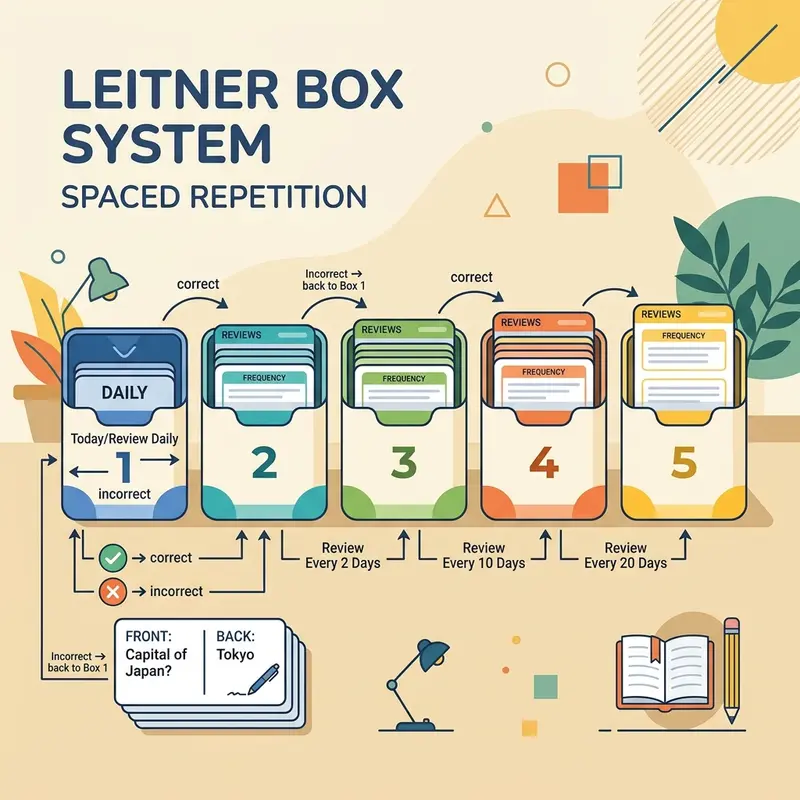
If you prefer physical flashcards over digital tools like Anki, you can implement spaced repetition using the **Leitner System**. This method uses five physical boxes to track card review frequencies:
- Box 1: Reviewed daily. All new flashcards start here.
- Box 2: Reviewed every 2 days.
- Box 3: Reviewed every 5 days.
- Box 4: Reviewed every 9 days.
- Box 5: Reviewed every 14 days. These are concepts you have mastered.
The Rules: When you review a card from Box 1 and answer it correctly, move it to Box 2. If you answer it correctly again, move it to Box 3. If you make a mistake on a card at *any* stage (even Box 5), it must go all the way back to Box 1. This system ensures you spend the majority of your time studying the concepts you find most difficult.
4. Interleaving vs. Blocked Practice
Another important cognitive concept is **Interleaving**. Most students study using "blocked practice"—spending a week studying only Unit 1, followed by a week of Unit 2.
Interleaving, on the other hand, involves mixing different topics or question types during a single study session (e.g., doing a practice session with 5 chemistry equations, 5 biology MCQs, and 5 history SAQs). This mix simulates the actual exam condition, where questions are randomized. It trains your brain to select the correct analytical tool rather than simply applying the same tool repeatedly.
5. Actionable Blueprint for AP Exam Prep
To apply cognitive science to your studies, implement this weekly routine:
- Daily Flashcard Session (15 minutes): Spend 15 minutes reviewing your Anki or Leitner flashcards.
- Weekly Blurting (30 minutes): Once a week, choose a challenging unit, close your notes, and write down as much information as you can. Open your notes, check what you missed, and add those details in a different color pen.
- Weekly Practice Questions: Do not save practice tests for the end of the year. Attempt 10-15 multiple-choice questions or 1 SAQ under timed conditions every week.
Conclusion
By moving away from passive reading and embracing active recall, spaced repetition, and interleaving, you will study more efficiently and build durable memories. This scientific approach is the most reliable path to securing a 5 on your AP exams.
- Brown, Peter C., Henry L. Roediger III, and Mark A. McDaniel. Make It Stick: The Science of Successful Learning. Harvard University Press, 2014.
- Oakley, Barbara. A Mind for Numbers: How to Excel at Math and Science. TarcherPerigee, 2014.
- Ebbinghaus, Hermann. Memory: A Contribution to Experimental Psychology. Teachers College Press, 1913.