
Introduction
One of the primary motivations for taking Advanced Placement (AP) exams is to earn college credit before stepping onto a university campus. Saving semester hours can translate into thousands of dollars in tuition savings and allow students to graduate early or pursue double majors. However, AP credit policies are highly decentralized.
A score of 3 on an AP exam might earn you a full semester of introductory course credit at a public state university, while the same score might receive zero credit or only advanced standing at a selective private institution. In this comprehensive guide, we compare AP credit policies between state systems and highly selective private universities, explaining how to interpret registrar tables and maximize your credit yield.
1. Public State Universities: Guaranteed Credit Mandates
In recent years, many state legislatures have passed laws mandating that public colleges and universities award credit for AP scores of 3 or higher. These state-wide articulation agreements are designed to reduce the cost of higher education for state residents.
For example, in the state of **Texas**, Senate Bill 111 mandates that all public institutions of higher education must award undergraduate credit to entering freshman students who have scored a 3 or higher on all AP exams, unless the institution can provide evidence that a higher score is required for a specific course prerequisite. Similar laws exist in **Ohio**, **Colorado**, **Indiana**, and **Florida**.
"The state-mandated AP credit policy has saved our family over $8,000 in tuition fees by allowing my child to skip three introductory general education requirements before their freshman year." - Feedback from a Texas State Parent Council Representative
In the **University of California (UC)** system, students who earn scores of 3, 4, or 5 on AP exams receive systematic quarter credits toward graduation. For instance, scoring a 3 or higher on AP US History grants a student 8 quarter units (equivalent to 5.3 semester credits) that apply directly to their graduation total.
2. Highly Selective Universities: Placement vs. Credit
Highly selective private universities, such as members of the Ivy League, Stanford, and MIT, operate under a different set of rules. Because these institutions have highly customized core curricula and require students to complete most coursework on campus, they rarely award general graduation credit for AP scores.
Instead, they use AP scores for **placement** or **advanced standing**. This means that a student with a score of 5 on AP Chemistry cannot skip a semester of graduation requirements, but they *can* skip the introductory general chemistry lecture and enroll directly in organic chemistry or advanced laboratory seminars as a freshman.
Let's look at a comparative breakdown of how different universities treat a score of 5 on AP Chemistry or AP US History:
| University | AP Subject | Required Score | Credit Granted | Policy Type |
|---|---|---|---|---|
| University of Florida | AP US History | 3, 4, or 5 | 6 semester credits | General Credit Transfer |
| Harvard University | AP US History | 5 | 0 credits (Advanced standing only) | Introductory Course Waiver |
| Ohio State University | AP Chemistry | 3, 4, or 5 | 5 semester credits | General Credit & Lab Equivalency |
| Yale University | AP Chemistry | 5 | 2 acceleration credits | Used only for early graduation |

3. Understanding General Education (GenEd) vs. Major Requirements
Even at universities that award credit for AP exams, it is crucial to understand *how* those credits are applied:
- General Education / Breadth Credit: AP credits are most valuable when they satisfy general education requirements (e.g., humanities, social sciences, natural sciences). This allows STEM majors to skip history requirements, and humanities majors to skip math or biology requirements, saving time for elective classes.
- Major Prerequisites: If you plan to major in Biology, earning a 4 or 5 on AP Biology might waive the introductory biology course, but some departments strongly advise majors to take the university's introductory courses anyway, as they contain foundational laboratory components needed for upper-level coursework.
- Unrestricted Elective Credit: Sometimes, AP credits do not satisfy any specific general education requirement or major course. In these cases, they are categorized as "unrestricted electives." While they help you reach the total credit count required to graduate, they do not help you skip specific mandatory coursework.
4. The AP Capstone Diploma Credit Advantage
Students who complete **AP Seminar** and **AP Research**, along with four additional AP exams, earn the **AP Capstone Diploma**. While individual universities evaluate Seminar and Research scores on a course-by-course basis, admissions offices look highly upon this diploma because it demonstrates undergraduate-level research and writing capacity. Many public university honors programs automatically waive freshman thesis requirements for Capstone Diploma holders.
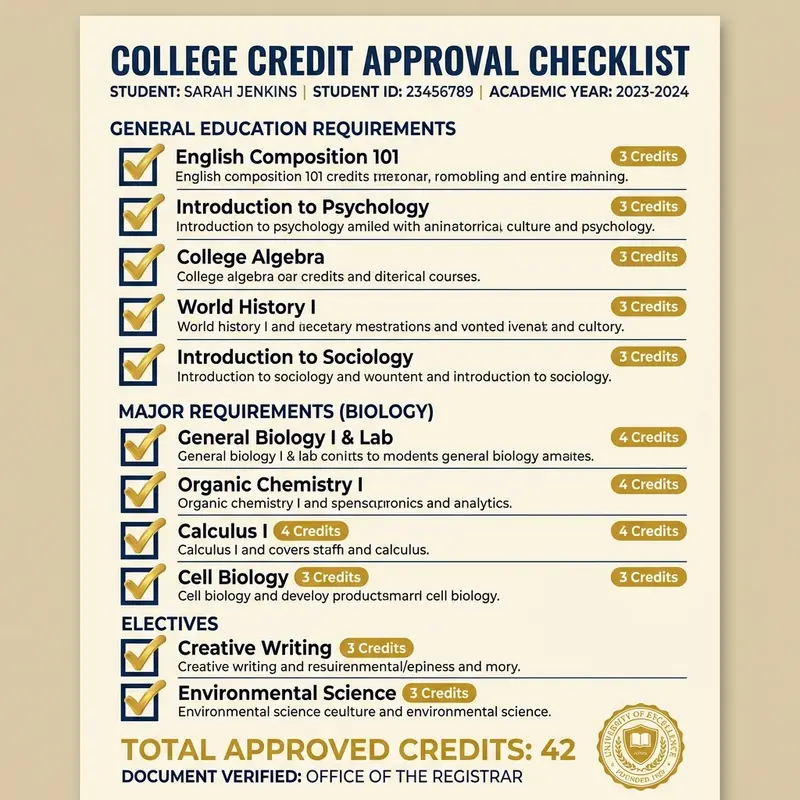
5. Actionable Checklist for High School Students
To ensure you do not leave credit on the table, follow these steps before and after taking your AP exams:
- Research Placement Tables: Visit the official registrar page of your target universities and search for "AP Credit Placement Tables." Verify the specific cutoffs for your subjects.
- Use the College Board Transfer Tool: Use the College Board's official "AP Credit Policy Search" engine to compare policies across multiple colleges side-by-side.
- Send Official Scores: Make sure you take advantage of the free score report sent by the College Board in July. Select your finalized college choice to avoid paying extra score delivery fees later.
- Consult Your Academic Advisor: During summer orientation, sit down with your university advisor and review your AP score report to confirm exactly which courses are waived and adjust your fall semester schedule accordingly.
Conclusion
AP exams are a powerful tool for reducing college costs and creating academic flexibility. By understanding the differences between public state mandates and private university placement rules, you can set realistic goals, study strategically, and get the most out of your hard work.
- College Board AP Credit Policy Search Engine
- University of California AP Credit Transfer Guidelines and Course Breadth Frameworks.
- State of Texas Higher Education Coordinating Board, SB 111 Articulation Reports.