
Introduction
Every June, thousands of high school AP teachers and university professors gather in convention centers and log onto secure online portals for a massive annual event known as **The AP Reading**. Sponsored by the College Board and Educational Testing Service (ETS), the Reading is where millions of student essays, equations, and lab analyses from Section II of the AP exams are graded.
To demystify this process and help students write essays that align with reader expectations, we spoke with seasoned AP history readers and science graders. In this article, we'll go behind the scenes of the AP Reading, detail the rigorous calibration protocols used to ensure grading accuracy, and outline specific writing techniques that satisfy graders on test day.
1. What Happens at the Annual AP Reading?
The AP Reading is one of the largest grading operations in the world. For one week, educators spend eight hours a day grading a single FRQ question or rubric component repeatedly. This hyper-focus is intended to build deep expertise and consistency in grading.
To prevent bias, student identities are completely hidden. Readers view scans of student writing identified only by a randomized barcode. Furthermore, individual readers do not grade a student's entire exam; instead, one reader will grade Question 1, another will grade Question 2, and so on.
"People think AP grading is subjective, but it is actually highly standardized. We are trained to search for specific conceptual milestones. We do not reward flowery prose; we reward clear, fact-based answers that meet the rubric requirements." - AP US History Grader interview

2. The Calibration Process: Ensuring Grading Fairness
Before a single student exam is scored, readers undergo a strict **calibration** process. This involves:
- Sample Review: Leaders select "anchors" (real student papers from the current exam representing different score levels).
- Group Practice: Readers grade these anchor papers together, discussing why a specific paper earned a point and why another fell short.
- Blind Testing: Readers must pass standard qualification tests. They grade a set of pre-scored samples; if their grading deviates from the established scores, they receive additional coaching before they are allowed to grade student exams.
- Continuous Auditing: Table leaders periodically audit pre-graded exams to check for "grading drift" (graders becoming more lenient or harsh over time).
3. Grader Insights: Specific Tips for Writing FRQs
We asked official readers to identify what separates a score-5 essay from a score-3 essay. Here is what they recommend:
Tip 1: Use the "State, Define, Explain" Method
For conceptual questions in courses like AP US Government, AP Psychology, and AP Biology, use a clear three-step writing structure:
- State: Directly answer the prompt using precise terminology.
- Define: Define the term or concept you just stated.
- Explain: Describe the mechanism of cause-and-effect. Use words like "because," "therefore," and "as a result" to connect your facts to the prompt.
Tip 2: Write with Legibility and Structure
While readers are trained to read difficult handwriting, a messy essay can make it harder for a grader to locate your arguments. Use clear paragraphs, label your answers corresponding to the prompt sections (e.g., Part A, Part B), and write with dark blue or black ink.
Tip 3: Do Not "Dump" Unnecessary Information
Some students use a strategy called "laundry listing"—writing everything they know about a historical period or biological pathway in the hope that some of it is correct. Graders warn that this can backfire. If you write contradictory information, you will lose the point. Keep your responses focused on the specific question asked.
4. Common Misconceptions About AP Grading
Let's address several common myths regarding how AP exams are scored:
| Myth | Reality |
|---|---|
| "Grammar and spelling errors will lower my score." | AP readers grade Section II holistically as a draft. As long as spelling or grammar errors do not obscure the biological or historical meaning, you will not lose points. |
| "If I write a long essay, I will get more credit." | Length does not correlate with points. A concise, one-page essay that hits all rubric requirements will earn a 6/6, while a four-page essay lacking thesis and sourcing will score a 2/6. |
| "I must write a concluding paragraph." | Conclusions are not required. It is better to spend your remaining time refining your thesis or adding historical context than restating what you have already written. |
5. Actionable Essay Outline Template
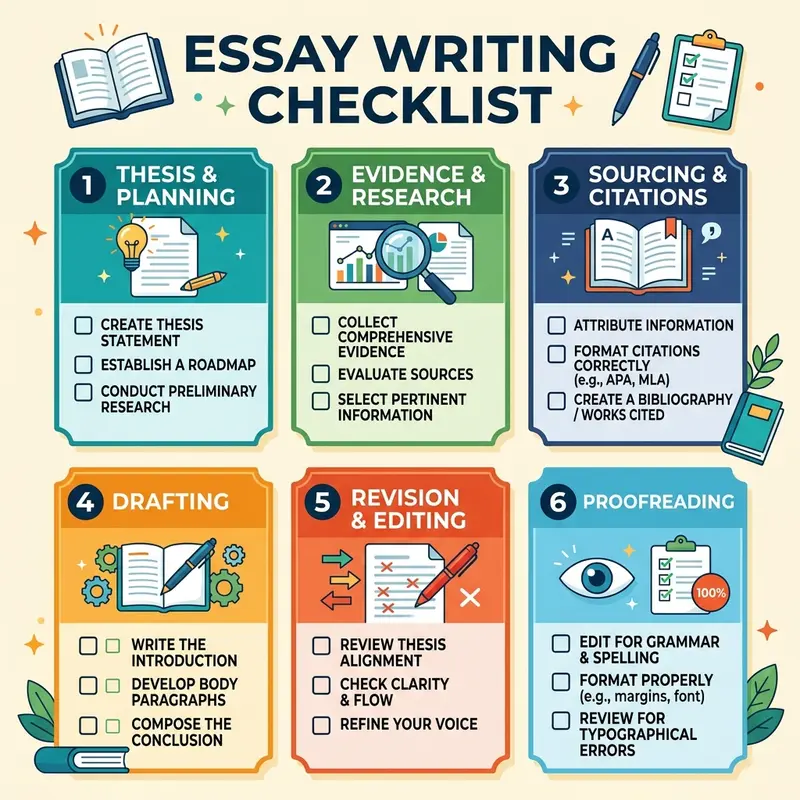
When planning your DBQ or LEQ essays, use this reliable structure:
- Paragraph 1: Contextualization & Thesis
• Set the stage: Describe the historical developments that led to the event in the prompt (3-4 sentences).
• Thesis: Clearly state your argument with a line of reasoning (e.g., "Although X, Y because A and B"). - Paragraph 2: Supporting Point A (Evidence and Sourcing)
• Topic sentence: Outline your first major supporting point.
• Document analysis: Integrate documents (in DBQ) or historical facts (in LEQ) to support this point.
• Sourcing: Explain HIPP for at least 1 document. - Paragraph 3: Supporting Point B (Evidence and Sourcing)
• Repeat the structure for your second major line of reasoning.
Conclusion
Demystifying the AP grading process helps reduce test anxiety and allows you to write with greater purpose. Focus on answering the prompt directly, use specific vocabulary, and construct clear paragraphs.
- College Board: About the AP Reading and Scoring Standards
- Educational Testing Service (ETS) Publications on Scorer Agreement Rates and Reliability Statistics.
- Interviews with official College Board AP Readers (2024-2025 cohort).